
Chatty and funny at home. Completely silent at school or around anyone unfamiliar. If that sounds like one of your clients, you have probably also heard it written off as shyness, by parents, by pediatricians, sometimes even by other well-meaning professionals.
Selective mutism affects roughly 1 in 100 children, and most do not get a diagnosis or start treatment until age 6 to 8. It is a distinct, diagnosable childhood anxiety disorder, closely related to social anxiety disorder, and one of the more treatable presentations we see in child therapy, when it is approached with the right exposure-based framework.
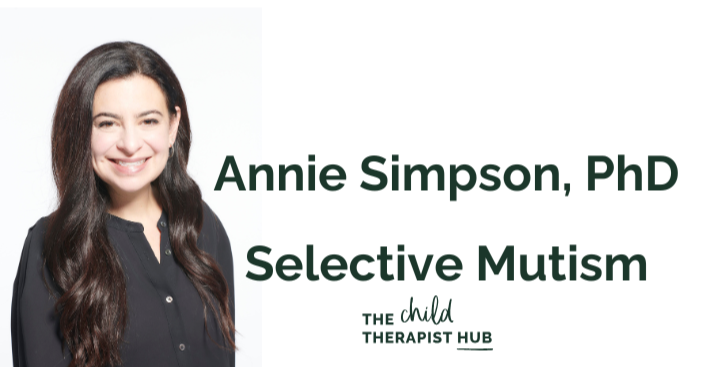
This month inside The Child Therapist Hub, Dr. Simpson, who has spent 20 years specializing in selective mutism treatment and childhood anxiety disorders, walked our members through her clinical approach. Below are three insights from that training that every child therapist working with anxious or non-speaking kids should know.
1. The "Rescue" Is the Reinforcement
The cycle that keeps selective mutism going usually starts with someone trying to help. A stranger asks a direct question, the child freezes, and a parent or teacher answers for them. Everyone feels relief in the moment, and the child just learned, again, that silence gets rescued.
For therapists doing exposure-based work with selective mutism, this pattern is critical to recognize early in treatment. Dr. Simpson broke down exactly what this "rescue" moment teaches a child, along with the small, everyday accommodations that reinforce avoidance without any adult meaning to. It is one of the most immediately useful reframes for therapists building a treatment plan around graduated speaking exposures.
2. Not Every Child With Selective Mutism Has Social Anxiety
Most clinical training repeats the same statistic: up to 90% of kids with selective mutism also meet criteria for social anxiety disorder. Dr. Simpson's clinical read, supported by more recent research, puts that number closer to 60 to 65%.
So what is driving the silence in the remaining subset of children? Dr. Simpson has a distinct case conceptualization for these clients, and it changes how a therapist should structure assessment, treatment planning, and exposure hierarchies for that group. Understanding this distinction is especially important for therapists who feel stuck when a "textbook" selective mutism protocol is not producing progress.
3. Selective Mutism Treatment Requires Two Distinct Skill Sets, and Skipping One Stalls Progress
Dr. Simpson described selective mutism treatment as requiring two separate, sequential phases:
Connection building, with zero pressure on the child to speak
Brave talking, which deliberately introduces just enough manageable discomfort to build speaking behavior through gradual exposure
Therapists who only work through the first phase, she noted, often end up with years of non-directive, rapport-focused sessions and a child who adores their therapist and still will not speak to them. Effective selective mutism treatment depends on moving deliberately into the second phase once connection is established.
Dr. Simpson shared the specific clinical techniques for both phases inside the full training, including exact question types to use with a non-speaking child, how long to wait for a verbal response before adjusting your approach, and how to fade a parent out of session without derailing the child's progress.
Why This Matters for Your Caseload
Selective mutism is frequently misdiagnosed as shyness, missed in early assessment, or treated with generic play therapy that never targets the speaking behavior directly. For child therapists building an exposure and response prevention (ERP) based practice, having a clear, sequenced protocol, and knowing which clients fall outside the typical social-anxiety-driven presentation, can be the difference between a stalled case and real clinical progress.
Watch the Full Training Inside The Child Therapist Hub
The Child Therapist Hub is a membership community for exposure-based child therapists, featuring monthly guest expert trainings, a monthly consult call, and a growing library of resources organized by treatment phase, from assessment through relapse prevention.
Learn more about Dr. Annie Simpson:
Follow her amazing social media account: https://www.instagram.com/generation.brave/
Buy her book! https://a.co/d/08gVAm8Q