
Child anxiety and OCD treatment in St. Louis.
Specialized care for kids with anxiety and OCD and the parents trying to help them.
If you’re here, you’ve probably been watching your child struggle for awhile. Maybe it’s the bedtime fears the keep the whole family up for hours, the questions they ask you over and over, the mornings where everything falls apart before school, or the fears that have slowly made your family’s world smaller. You’ve tried reassuring them, reasoning with them, maybe you even tried a therapist that was really nice but nothing changed. Our team treats only anxiety and OCD in kids, teens, and adults, so the care your child gets here is specific, structured, and build on what the evidence tells us actually works.

Does this sound like your child?
OCD can look like:
Needing to feel ‘just right’ to avoid a meltdown
Excessive handwashing, counting, checking, asking, analyzing
Asking the same question over and over - the answer is never enough
Scary and upsetting thoughts that won’t go away and cause fear or shame
Rituals that take over bedtime, dinner, school, family time
Avoidance of places, people, words, or objects
Excessive actions to try to prevent fear from coming true
Anxiety can look like:
Refusing to go to school or daily battles to get there
Panic about separation, even at home
Fears of throwing up, needles, storms, or bad things happening
Freezing up or shutting down in social situations
Avoiding anything that might cause the worry to come up
Refusing to go to birthday parties or playdates
Stomachaches, headaches and regular complaints of being sick
Panic attacks or fears about getting one
We use proven treatments to get your child and you back on track.
-
Practical skills for noticing anxious thoughts, understanding how they connect to feelings and behaviors, and responding differently.
-
Your child learns to face fears in small, planned steps while resisting the urge to ritualize, avoid, or seek reassurance. With kids, we make this playful and collaborative. Your child sets the pace, and we build confidence one win at a time.
-
A parent-focused approach for when your child won't or can't engage in therapy. You learn to reduce the accommodations that keep anxiety going while staying warm and supportive. Research shows this works even when the child never attends a session.
-
While ICBT is not yet evidence-based for children, it is a form of Cognitive Behavioral Therapy that addresses OCD symptoms without asking kids to directly face fears. This can be an option we will explore if your child is not responding to Exposure and Response Prevention.
Why families choose us:
We specialize. Every therapist on our team is trained in ERP and treats anxiety and OCD exclusively.
We teach other clinicians. Our founder trains child therapists across the country in exactly this work.
Parents are part of the plan. You'll leave with tools, not just a drop-off appointment.
We're honest about progress. Treatment has a clear structure and goals, and you'll know how it's going.
Who will my child be working with?
-

Angela Springer, LCSW
Owner and Therapist
-
Samantha Simonetti, LCSW
Therapist
-
Hayley Wyatt, LCSW
Therapist
-

Madeline Goodwill, LCSW
Therapist
-

Lauren Goldberger, LCSW
Therapist
-

Lucie Taylor, LMSW
Therapist
What to expect:
Fill out our short contact form.
We match you with a therapist trained in what your child is facing.
Your first session includes an assessment and an overview of a plan.
Most kids see meaningful change within a few months of consistent work.
Location and Fees:
We see families in person at our Clayton, Missouri office and online anywhere in Missouri. We also have clinicians that can see families virtually in Illinois, Wisconsin, Arizona, and Indiana. We're a private-pay practice, which means no diagnosis requirements from insurance, no session limits, and a therapist chosen for fit rather than network. We provide superbills so you can submit for out-of-network reimbursement, and many families recover a meaningful portion of the cost. Our intake fee is $225 and session rates vary by clinician from $110 - $225 per session.
Ready to Get Started?
Frequently Asked Questions
-
We typically work with ages 7 and older. If you have a child that is under 7 we often recommend meeting with us, without the child present for parent coaching sessions.
-
Refusal is common, and it's usually anxiety doing the talking. We recommend framing the first visit as a first meeting, not a commitment: "We're going to meet someone who has helped a lot of kids with exactly the kind of thing that's been hard for you. You don't have to talk about anything you don't want to. Afterward, we'll talk about how it went." Our offices are set up for kids and teens, and our therapists are skilled at earning buy-in from even the most reluctant ones. And if your child still won't come, we can start with you. Through SPACE, parents learn to change the patterns that keep anxiety going, and research shows kids improve even when they never attend a session.
-
Most kids who come to us have already seen a therapist, and most of those therapists were caring and skilled. The difference isn't effort or warmth. It's method. Anxiety and OCD don't respond well to talking about feelings, exploring where the worry came from, or learning coping strategies in the abstract. They respond to practice: facing the feared thing, in small steps, until the brain learns it's safe. That's Exposure and Response Prevention, and it's the treatment with the strongest evidence for both conditions. Every therapist here is trained in it and uses it from the start. You'll also notice a different structure. Sessions have a plan, your child has homework between them, you're involved rather than in the waiting room, and we track progress so you can see whether it's working. If you've been in therapy for months and can't point to what's changed, that's usually a sign the approach needs to change, not that your child can't get better.
-
Every child and family is different, so there's no single answer, but here's what to expect. We typically begin with about eight weekly sessions. During this time we get to know your child, understand what's driving the anxiety or OCD, and build a treatment plan together, one that includes specific steps for your child and for you as the parent. Anxiety and OCD are family conditions in the sense that they affect everyone in the home, and parents are often the most powerful part of treatment. After those first eight weeks, we'll check in and evaluate whether it makes sense to move to every-other-week sessions. Factors like the severity of symptoms, how long they've been present, and how consistently the plan is practiced at home all shape how quickly a child progresses. Our goal is always to work ourselves out of a job: we want your child and your family to leave treatment with the tools to handle anxiety on your own.
-
It depends on where we are in treatment and what your child needs. The very first appointment is for parents only, and your child does not attend. This gives us a chance to hear the full picture from you and make a plan together before your child ever walks in the door.
For your child's first session, our general preference is to meet with them one on one. It's simply easier to build a relationship with a child when they aren't leaning on you to answer questions or wondering whether they should engage. On that first day, we'll come out to the waiting room, introduce ourselves, and say something like, "Hey, let me show you my office, and we can come back and get your parent in a little bit if we decide to." All of this is adjustable, and we'll talk through what feels right for your child during the parent-only appointment.
Beyond that, it varies. We often like to have parents present for large portions of sessions, because a big part of our work is helping you understand how to support your child at home. We'll plan this with you specifically rather than following a one-size-fits-all rule.
-
Almost every parent we work with asks this question, or wants to. So let's start here: no, this is not your fault.
From the moment you first noticed your child struggling, you've been trying to help. You've most likely been doing everything you can think of to reduce their suffering, adjusting, reassuring, problem-solving, searching for answers. The fact that you're reading this and considering an appointment says the same thing. You care, and you want to know what to do.
As we work together, we'll look at changes you can make in your role as a parent that help your child move forward. That's not blame. It's recognizing that you have real influence, and we're going to help you use it in the ways that work best.
-
We usually recommend keeping it simple and low pressure. You might say that you found a person who works with lots of kids just like them, kids who struggle with some of the exact same things, and that you've set up a time for them to meet. Something like: "I just want you to meet them and see what you think. We can talk about it afterward and decide what we want to do."
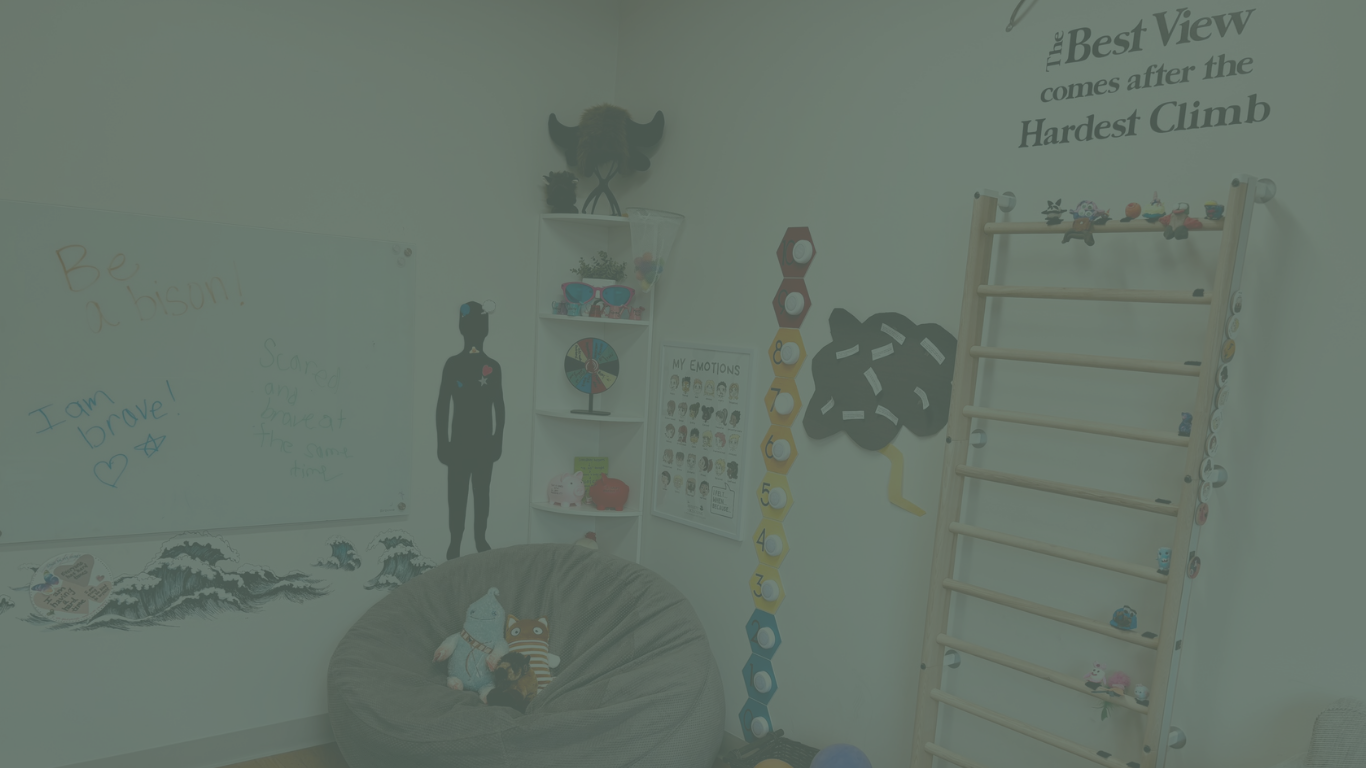
It also helps to let your child know that the first appointment is mostly just hanging out and getting to know each other. If it's in person, the therapist's office has a lot of cool things in it, and your child is never expected to share anything they don't want to share.
Many kids also feel relieved to hear that their parents have already met with the therapist, so the therapist already knows some of what's been going on. That takes the pressure off having to explain hard things themselves.
-
We'll schedule a parent-only appointment.
You'll receive an email with intake paperwork to complete through our secure client portal.
You'll attend the parent-only session, where we will get more information to understand the problem.
Your child will then attend their first session with their therapist.
After this, we will work together to determine the structure of the sessions moving forward.
-
No. We are therapists, not medical doctors, so we don't prescribe medication. That said, if your child is working with a pediatrician or psychiatrist, or you're considering medication as part of treatment, we're happy to collaborate with them so that everyone caring for your child is on the same page.Item description
-
Possibly. All of our clinicians offer virtual sessions to families anywhere in Missouri, and several of us also hold licenses in Arizona, Illinois, Indiana, and Wisconsin. If your child lives in one of those states, we may be able to help. Licensing rules require that the child be physically located in a state where the therapist is licensed at the time of the session, so let us know where you're located when you reach out and we'll match you with a clinician who can work with you.